What does the data represent?
- A customer and a policyholder
- Written premium and earned premium
- A claim and a claim transaction

Why the semantic layer matters when organizations move from trusted data to usable intelligence.
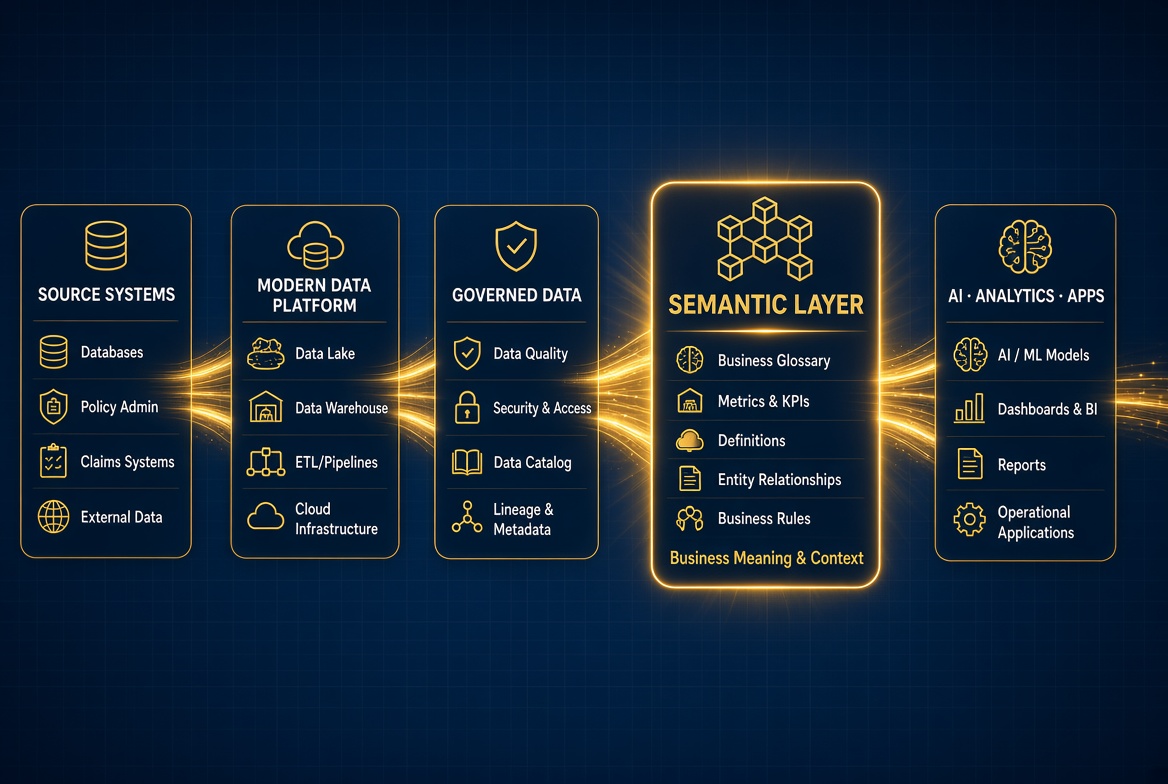
An insurer may have thousands of databases, millions of records, hundreds of reports, and years of accumulated business rules. TDWI's 2026 research finds that organizations cannot simply place a large language model on top of existing data and expect accurate, trusted, repeatable results. Generative BI requires an architecture designed for both people and AI.[1]
Data provides the raw material. Business context, governed meaning, trusted metrics, and operational controls make that information usable by AI.
Which loss ratio? Is it written premium or earned premium? Are losses paid or incurred? Are allocated loss adjustment expenses included? What time period applies? Which business segment? Which policies are included?
Different systems may produce different answers, all of which appear technically correct. The problem isn't necessarily bad data. The problem is the absence of shared business meaning.
TDWI's survey of 208 organizations shows that the business case is not primarily about replacing analysts. The leading drivers are productivity, faster insight generation, and better decision-making—and the research identifies business context as a strategic requirement for making those capabilities trustworthy.[1]
cite productivity improvement as a primary driver for generative BI.
cite faster insight generation as a primary driver.
cite better decision-making as a primary driver.[1]
These distinctions may be obvious to an experienced insurance executive. They are not necessarily obvious to an AI system simply because the underlying data exists. TDWI describes the semantic layer as the mechanism that translates technical data into governed business concepts—metrics, dimensions, hierarchies, calculations, and relationships—and makes those definitions reusable across BI, AI applications, and agents.[1]
Traditional data architecture has focused on moving and storing information. AI introduces another requirement: access to the organization's understanding of its data.
TDWI's Blueprint organizes generative BI around four interconnected layers. Business strategy and use-case selection guide the stack, while people and operating model, governance/security/trust, and evaluation/testing/operations apply across every layer.[1]
Data acquisition, integration, storage, quality, governed access, metadata, lineage, scalable performance, and integrated structured and unstructured data.
Agreed metrics and KPIs, semantic models, business glossaries, taxonomies, ontologies, knowledge graphs, and domain-specific context.
LLMs, retrieval and grounding, semantic query translation, text-to-SQL, analytical tools, agent orchestration, and response generation.
Conversational analytics, dashboards and reports, AI-generated narratives, recommendations, decision support, and increasingly AI-assisted and agentic analytical workflows. TDWI emphasizes that dashboards do not disappear; generative BI extends analytics beyond predefined views and into the workflow itself.[1]
TDWI describes a progression from natural-language questions toward AI-assisted analytical workflows: identifying the right metric, comparing periods, analyzing segments, investigating drivers, synthesizing evidence, and recommending next steps.[1]
Users can ask questions in business language rather than navigating every predefined report or writing SQL.
AI can move beyond retrieval to compare results, examine segments, evaluate evidence, and explore likely drivers.
Increasingly, AI can support recommendations and multi-step workflows—raising the importance of governed metrics, boundaries, testing, and human review.[1]
TDWI identifies governance gaps, organizational silos, and lack of ownership/stewardship as the leading challenges to semantic consistency. The report also calls for representative question sets, “gold” answers, correctness and consistency testing, regression testing, monitoring, and incident management.[1]
Can the organization define the right metric, provide trusted data and business context, show where the answer came from, test whether it remains correct, and establish when AI should defer to a human? TDWI's research suggests that these complementary capabilities distinguish organizations moving from isolated experiments toward measurable business impact.[1]
What decisions do executives, underwriters, claims leaders, actuaries, and operations managers need better information to make?
Define the customers, policies, claims, premiums, exposures, expenses, losses, and other concepts that support those decisions.
Create agreement about what those concepts mean and how they should be measured.
Map business concepts to the underlying systems, data elements, calculations, and lineage.
Assign ownership, establish change processes, and continuously monitor quality.
Bring structured and unstructured information together through metadata, enrichment, retrieval, classification, and governance where the use case requires it.[1]
Define representative questions and expected answers, test correctness and consistency, monitor drift and cost, and maintain human oversight for high-impact use cases.[1]
Expose approved business definitions, relationships, metrics, and rules to the AI systems and agents that need them.
Higher-impact organizations are more likely to have trusted AI outputs, semantic and business-context technologies, prepared unstructured data, and governance and observability practices.[1]
TDWI's analysis does not identify one product or technology as the answer. Business value is associated with the accumulation of complementary capabilities across the architecture.[1]
The journey commonly expands from conversational access to trusted business context, prepared enterprise information, operational governance, and ultimately AI-native and agentic analytics.[1]
AI readiness starts with the organization's trusted data, business context, governance, and decisions — not with an AI tool.[1]
Then build the trusted data, business context, governance, and evaluation capabilities required to move from AI experimentation to reliable business use.